The next Big Gun on my list is the Rokkit Launcher, which is terrible 90 percent of the time and the other 10 percent of the time destroys everything on the table. Very orky.
I made mine based on the one from the Deff Dread kit. I think. I decided to make the two rokkits removable for times in Gorkamorka when you run out of ammo. Of course, this meant I now had to drill some holes in order for the rokkits to slot back in. Which wasn’t too bad. I then glued some brass tube into the rokkits and they were ready to go.
To attach it to my magnetic gimbals, I filed-down the ball joint that normally connects to the Dread. I then cut a big plasticard ring to extend the joint and a smaller one to hold the magnet. I then filled the gap between the two rings with sprue goo and topped that off with green stuff, which was easier to smooth.
I went a bit overboard painting the rokkits with some tiny cheques. I ended up having to paint some of it with a toothpick because I couldn't keep the point on my brush sharp enough.
In general, I’m pretty happy with how the Rokkit Launcher turned out. Definitely not the most complicated conversion, but along with the paint job, I think it fits in with my other Big Gunz quite nicely.
Way back during our first Gorkamorka campaign, I was careful to make sure that all the gubbinz for my mob were modular so that I could slowly acquire them to upgrade my vehicles throughout the course of the campaign. Of course, gubbinz aren't the only way to upgrade one's vehicles in Gorkamorka—you can also upgrade your guns.
At the time, I didn't have the time or the bitz to make a set of fully modular weapons for my vehicles, so I've been using the same Big Gunz in every campaign we've played. But at last I've finally gotten around to making a proper set of weapons, starting with a spear gun.
The first step was to create a way to mount the weapons on my vehicles. I decided to create a magnetic gimbal based on the weapon mount from the old Ork Wartrakk, which is what I was using before. I essentially just built a slightly larger, magnetized version out of plasticard. All things considered, I think they turned out looking pretty good.
For the spearheads, I decided to use some old Warhammer Fantasy grot spears that I happened to have lying around. I initially thought about about leaving the haft of the spears attached and just sliding them into a plasticard tube, but that would have meant using much bigger tubes, so I ended up just cutting the heads off. And since I didn’t need the tubes to be hollow anymore, I just made them with solid plasticard rod.
Next, I needed some kind of brackets or crossbars to hold the tubes together, so I found a piece of plasticard I had lying around and cut it to size.In order for the clamps to wrap around the sides, I cut some tiny sections of tubing and then split the tubes lengthwise. I also had to trim the clamps a little bit so that the side pieces fit tightly to the plasticard rods.
Now that I was halfway through building my spear gun with four tubes straight in a row, I thought it might be cool to have a second one with the four tubes in more of a box arrangement. So I set about making some fittings, which I made by gluing four rings of plasticard tube together. I then threaded the rods through the fittings and then glued them in place.
I tried to find some bitz that looked like they could be air tanks for the pneumatic launcher, but everything I found was a bit too big. So I decided to make my own out of plasticard rods. I also glued on some thin rod to make the tubes connecting the air tank to the four barrels.
The next step was adding the rivets. Which is always kind of tedious, but really adds a lot of detail to the model. Even after the rivets, I felt like the spear guns lacked a bit of detail compared to the other guns, so I decided to create some little pressure gauges to go on the back next to the air tanks. I made the gauges by just gluing some thin rings to a sheet of plasticard and then cutting them out. The concept was simple enough, but I didn’t cut the rings quite as thin or as straight as I had hoped. Still worked, though.
Pretty much everything on the spear guns got painted metallic silver, so I painted the fittings on the boxy one to be brass and gave the one with the barrels in a row a red stripe on the end of the barrels.
The finished product turned out pretty good. They both came out with a nice brutal Mad Max vibe I could have made the pressure tanks brass as you often see with Ork contraptions, but the red gives some nice contrast with metallics on the other parts of the guns.
Very orky.
So at last, I'm no longer just limited to my 'Eavy Shoota (though it'll still be an option). I'm excited to test these out in an actual campaign, and there are a bunch more options coming up soon.
I've been slowly working on a few projects over the last few months and one of them is finally finished. I've converted my second Ork Wartrakk...again. It's been missing a wheel since my then-five-year-old got his hands on it, but there were always a few other things I wasn't completely satisfied with after I finished converting it. The front fenders were a bit underwhelming, the weapon mount put the scorcha above the gunner’s head, and despite being quite tall, it didn’t really feel as boxy as I wanted. So I decided to tackle all these issues at once.
The first step was getting some new wheels. One of the reasons used the same standard wheels as the one on the front of the Wartrakk was because they were one of the standard 40K wheel sizes, which meant you could easily order replacements from Games-Workshop. But then GW stopped selling them, so I had to come up with a different plan.
To replace the wheels on my little firecar, I eventually landed on the wheels from the Genestealer Cults Achilles Ridgerunner. These ones were quite a bit bigger than my previous wheels, which would require some redesigning.
I didn’t want the whole vehicle to tilt backwards, so I’d have to elevate the rear enough that it tilted forward instead. To do this, I decided to build my little trakk a proper undercarriage, like the one my big trakk. I also probably went a bit overboard with my dismantling and ripped off a few bits that I probably should have just left alone. Oops.
I made the basic frame of the vehicle with some long plasticard strips and some H-beams. I also added a ram mount on the front. I also put some brass rods in the Ridgerunner wheels to make them detachable.
I also built a ridiculously large transmission for the track out of a piece of a soap dispenser,
In order to have the trakk tilt forward, I had to drop the tracks below the rest of the frame, so they ended up basically turning into their own subframe. I used some brass rod to make some sturdy axles that wouldn't get bent or broken during normal use and I used part of a plastic twist-off cap (similar to those on a Squeezit cap) to make the differential.
Of course, while the brass axles themselves were pretty strong, I didn’t want those plastic joints supporting all the shearing stress on the bottom of the vehicle, so I cut some plasticard I-beams to connect the two sides.
Connecting I-beams at right angles was a bit tricky, but I just cut off the top and bottom of one beam so that they lock together tightly and ended up with a really great connection.
To connect the two subframes, I decided to model some pistons to look like a hydraulic suspension or adjustable traction bars. This would involve connecting tubes at some weird angles, so I started off by using some other bits of tube to make some connection points on the main portion of the frame that stuck out just beyond the flanges of the beams. I then chopped up some square tubing to make a C-shaped brackets on the track subframe.
A few little tubes at weird angles wasn't much to support the weight of the vehicle, so I decided that I needed something in the middle transferring the weight straight down.
My initial plan was to create two more, even smaller pistons to squeeze into the spot between the two frames, but they were just way too flimsy. Instead, I decided to create some springs out of some plastic worm gears. This meant that I could run some brass rod through the middle of the gears and solidly pin the two halves together.
The hard part was cutting the worm gears at an angle to match the upper frame. They're made of some pretty hard plastic and trying to cut them at an angle across their threads just made them want to spin. But eventually I managed to get them cut and they worked great!
The little suspension bars were surprisingly difficult to attach. Trying to hold them at the correct angle and extend them to the proper length when I couldn't even get my fingers in there was incredibly difficult. I used superglue and baking soda to get a quick bond, but even then I don't know how I kept them in position long enough to glue it all together.
The next step was making an engine for my little firecar. I used the engine from the Mek Workshop and simply cut away the chains that were attached to these bits. Taking inspiration from some of the crazy vehicles you see at tractor pulls, I made a little gearbox to go beneath the engine and ostensibly connect it to my oversized transmission below.
I also made some exhaust pipes out of plasticard rod. Working with such tiny tubes at very precise angles was challenging, so I ended up first cutting out some little plasticard guides and then gluing the rods to them. I could then maneuver all the pipes together and sand them down to the correct angle to attach to the engine block. I then sanded off the guides as best as I could, so the underside of the pipes is pretty messy, but they look good from above.
The next thing I decided to add were some roll bars around the driver. I also magnetized his seat, which made getting him in and out so much easier.
I also rebuilt the gunner's platform that I'd torn off and added a spot to add some gubbinz like a big grabba or a wreckin' ball.
At this point, I put things on hold for a bit to take my updated Firecar on a test drive. I played a short campaign with Cygnus and his brothers, which included my scorcha trakk going up against his scorcha buggy.
This particular encounter ended with both vehicles basically immobilized and their crews hopping out to beat each other up. Good times.
Once I got back to converting, the next step was making some new fenders. I spend a good deal of time sanding the joints to give them more of a smooth curve than the old ones had.
Before I stuck the two subassemblies together, I decided to airbrush them to make sure I got all the fiddly details painted. This ended up taking much longer than anticipated due to my airbrush being clogged and me accidentally shooting the nozzle across my kitchen while cleaning it.
Fortunately I did eventually get both halves painted and glued together properly. I made sure to mask out a few of the details that still looked good, as well as the connection points so I could stick them together with plastic glue.
I was also now able to add the front shocks that came with the Ridgerunner wheels and axle. Some very cool little bits.
I then painted up the trakk in my mob's classic Goff paint scheme, adding plenty of cheques where I could.
I'm pretty pleased with the finished result. My little firecar turned out nice and boxy like I had originally intended, without being any longer than it was before. And I can easily mount my second Big Grabba on it, which could be fun.
The ram mount on the front is also compatible with the ram on my big trakk, but it looks pretty ridiculous on my tiny trakk buggy, so a new ram is now on the list of future projects.
And if you want an even more in-depth description of the conversion process, I have a new video up on my YouTube channel.
After over four years of work, the fort is finally done! The last few years have been crazy (maybe a few others out there can relate), so I haven't had a ton of time to spend on crafting stuff, but it's very satisfying to have actually seen this project though.
I was trying to come up with a color scheme that looked appropriately eclectic for an Ork fort built from salvaged scrap, but also cohesive enough to look like an actual building that could exist within an environment. So the exterior armor panels of the fort are pretty much split, with half being bare metal, and the other half being painted.
The interior wall panels are mostly just metal, but this is balanced by all the little doodads like mushrooms, pipes, and tools, which are all pretty colorful.
My mob's colors are the traditional Goff colors of black, white, and red, but since this fort is for all the mobs in the campaign, I added the other mobs' colors, which also included yellow, blue, and purple. I mostly focused on red and yellow, since that covers about every old-school Ork clan except Snakebites and Deathskulls, so it gives the whole thing a very orky feel.
I also really like the way my little insignia over the gate looks all painted up.
The whole thing got pretty heavily weathered, which I think works really well with all the chains and machinery. I used quite a few methods of weathering on the fort, including stippling on rust and paint chips, enamel paints, oil washes, and even experimenting with Dirty Down rust. Most of which sort of worked.
I even managed to use some Dirty Down Moss on the sewer pipe to make it look appropriately gross.
The chunk of the 'Ulk turned out really well. In retrospect, I don't know why I left the engine nozzles shiny and silver when I weathered everything else so heavily. I probably just skipped it once during the months of on-and-off painting and then assumed I'd skipped it intentionally. Maybe I'll go back and rust it up later.
The big fuel tank was one of the first ideas I had for the fort and the only specialized wall section that was part of the original version from 2019. It’s pretty cool to see it finally finished and painted up.
The pipes look appropriately busy.
Speaking of busy, I probably went a bit overboard with the storage sections, but I like how all the mushrooms and other supplies turned out.
The electrical panels looked pretty good painted up. I’ll probably do something similar on other Ork buildings in the future.
The workbench also turned out really cool, but I attribute most of that to the Mek Workshop just being a generally cool piece of terrain.
The sleeping quarters changed a lot from my original concept. I kind of wish that I’d stuck a hammock or two in there, but I’m glad I didn’t take the time and effort to model a decent hammock. Maybe in a future build.
I also made little perches for my shoulder squigs.
So at long last, the fort is finally ready for the next campaign. It'll be exciting to play with proper terrain this time. Assuming we actually need a fort. I guess we'll see. If nothing else, it makes for a pretty spiffy Ork dollhouse.
Also, I started a YouTube channel, so you can see the whole painting process if you're into that sort of thing.
Belated fort update: I did, in fact, build one more random structure to the fort, a windmill. Every good Gorkamorka fort needs a windmill for power, so now all the random gizmos I built into the workshop can be put to good use.
I built it to be modular like the rest of the fort, not because I plan on having multiple versions I could swap out, but for ease of storage (a tall, skinny tower with sticky-out bits is just asking to get broken) and because you can move it around. It doesn't exactly spin well, but I still thought it was cool.
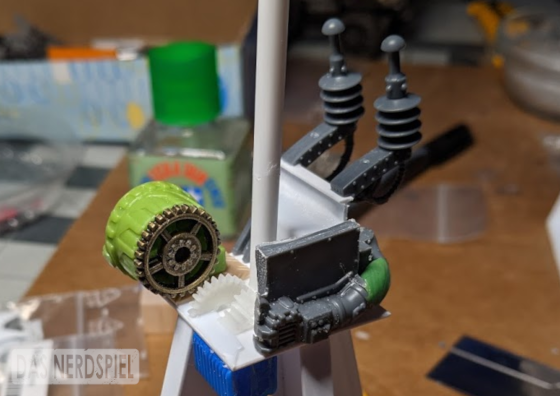
I used a bunch of random gears for most of the worky bits, as well as some high-voltage bushings that I think were part of the Mek Workshop that didn't make the cut for that section of the fort.
Anyhow, I think this officially ends the construction phase of the fort. Painting is now well underway and I hope to get the whole thing finished soon. Like soon soon, not a year or two soon. Fingers crossed!